
DHEA supplementation for men over 50 gets marketed like a shortcut back to the version of you who recovered faster, slept harder, and did not need a second cup of coffee to feel fully online. That’s the pitch. The evidence is less cinematic.
What makes this topic tricky is that the underlying biology is real. DHEA and its sulfate form, DHEA-S, do fall with age. Some clinical trials show modest rises in testosterone when older men take 50 mg per day. But the jump from “lab value moved” to “life improved” is where most supplement marketing starts doing cartwheels in the parking lot.
For a time-poor man trying to decide whether this is worth testing, buying, or ignoring, the useful question isn’t whether DHEA does anything at all. It’s whether the evidence shows a benefit large enough to matter in the real world, and for whom.
What Is DHEA and Why Does It Decline After 50?
DHEA is an adrenal hormone that serves as a precursor for both testosterone and estrogen. That sounds dramatic until you look at the normal aging curve and realize the decline is ordinary, not automatically pathological.
UCSF Health’s reference ranges make that clear. DHEA-S peaks early in adulthood, with a reference range of 110 to 510 ug/dL for men ages 18 to 29. By ages 50 to 59, that range shifts down to 25 to 240 ug/dL. The top end drops by more than half, and the decline keeps going from there. UCSF Health also notes that DHEA-S levels fall by roughly 2% per year after early-adult peak levels.
That matters because a lot of supplement copy treats any lower number after 50 as proof that something has gone off the rails. Usually it hasn’t. A lower DHEA-S level at 56 than you had at 26 is the baseline expectation, not a diagnosis.
The practical takeaway is simple: context first, pills second. If you have lab work showing low DHEA-S, the relevant question is whether it is low relative to the reference range, your symptoms, and the rest of your hormone picture. Looking at one aging marker in isolation is how people end up buying hormone-adjacent products for what is really a sleep problem, a body-composition problem, or plain old midlife wear and tear.
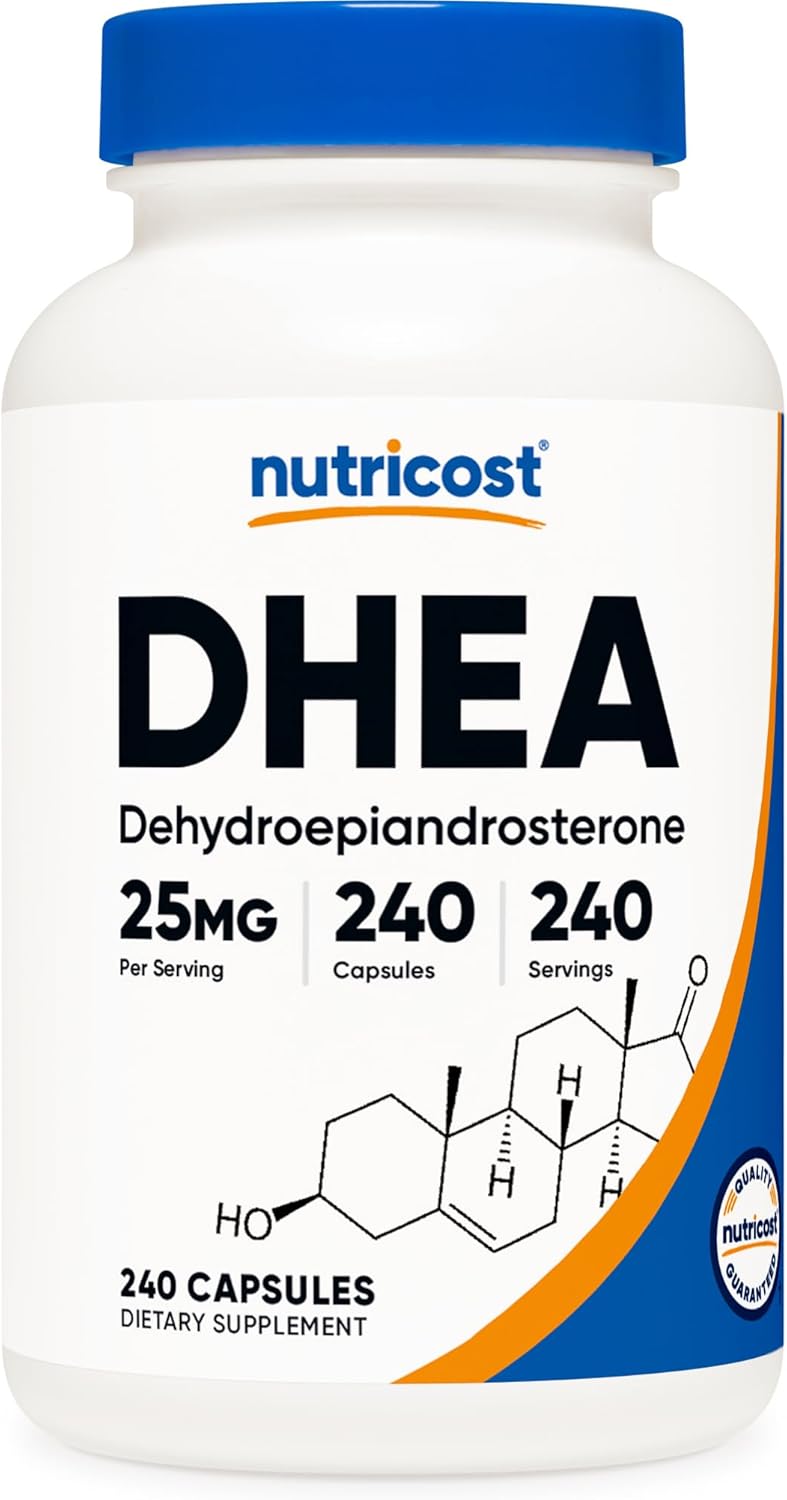
Nutricost DHEA 25mg
$14.95
This article contains affiliate links. We may earn a commission at no extra cost to you.
DHEA Supplementation Men Over 50: How It Affects Testosterone in Trials
This is the part of the conversation where the evidence is just strong enough to be interesting and not nearly strong enough to support the usual promises.
A 12-week trial in 58 men ages 65 to 75 found that 50 mg per day of DHEA increased free testosterone by 19% and total testosterone by 16%. On paper, that sounds meaningful. If your interest is strictly biochemical, DHEA can move the numbers.
The catch is what happened when researchers zoomed out. A 2013 meta-analysis in the Journal of Clinical Endocrinology & Metabolism pooled 25 placebo-controlled trials covering 1,353 elderly men. The authors found no sufficient evidence that DHEA improved sexual function, bone health, or quality of life in a reliable way. In other words, the serum changes did not consistently cash out into better outcomes a man would actually notice.
That gap matters more than the hormone bump itself. Plenty of interventions can nudge a biomarker. The real standard is whether the nudge changes strength, recovery, libido, mood, or day-to-day performance enough to justify taking the thing. With DHEA, that broader case is still weak.
So the straight take is this: if the goal is “raise testosterone a bit,” DHEA may do that in some older men. If the goal is “feel noticeably better across the board,” the pooled evidence doesn’t give a confident yes. That isn’t a scandal. It’s just a useful distinction that tends to get lost once the supplement bottle shows up under flattering lighting.
Body Composition and Bone Density: Modest Shifts, Not a Transformation
This is where DHEA has some of its better talking points, but they still need a reality check.
The same 2013 JCEM meta-analysis found a small but statistically significant reduction in fat mass among older men taking DHEA. That sounds encouraging until you hit the next sentence: the association lost significance after adjustment for increases in DHEA metabolites. Translation: even that modest body-composition signal may reflect downstream hormone conversion rather than a clean DHEA effect on its own.
Bone data are similarly mixed. In the 2-year randomized trial by Nair and colleagues, published in the New England Journal of Medicine in 2006, elderly men with low androgen levels saw an increase in bone mineral density at the femoral neck. That’s a real signal, and it is one reason DHEA keeps hanging around in longevity conversations.
But the story doesn’t stay clean. A separate 1-year trial in 133 men ages 60 to 79 found no beneficial effects on body composition or bone mineral density. The 2020 review in the World Journal of Men’s Health described the overall picture the way it should be described: conflicted, limited, and smaller than the marketing implies.
That doesn’t make DHEA useless. It makes it conditional. If a man over 50 has confirmed low DHEA-S, borderline bone concerns, and no contraindications, a clinician could reasonably view DHEA as worth discussing. If the expectation is a visible body recomposition or a dramatic anti-aging effect, that is the supplement version of airport-smooth jazz: technically music, but not what was promised.
Cognitive Function and Mood: Where the Evidence Falls Short
This is the section most likely to save someone money.
DHEA gets sold as a mental edge supplement all the time. Better focus. Better mood. Better resilience under stress. The mechanism sounds plausible enough that the claim survives first contact with a podcast microphone. The human evidence is where it thins out.
A Cochrane review found no beneficial effect of DHEA on cognitive outcomes in healthy adults over 50. The 2020 review in the World Journal of Men’s Health cites a 1-year randomized controlled trial in 110 men ages 55 to 85 that found no cognitive benefit either. That’s a long enough runway to be useful. If a supplement has meaningful cognitive effects for healthy older adults, a year is plenty of time to leave footprints.
Mood claims aren’t much stronger. Harvard Health noted in 2023 that preliminary evidence for depression improvement is low quality and that DHEA isn’t a first-line treatment for mood disorders. That’s the right frame. A plausible mechanism isn’t the same as a clinically dependable result.
For the Resilience reader, this is the important filter: if your real worry is losing sharpness, DHEA is probably not the first lever to pull. Sleep quality, obstructive sleep apnea, alcohol load, resistance training consistency, medication review, and a real hormone workup usually deserve attention before a supplement whose mental-performance reputation is doing more work than the data.
Dosage, Safety, and What a Man Over 50 Should Know Before Buying
If someone is going to try DHEA, the safety conversation matters more than the branding on the bottle.
Harvard Health and Mayo Clinic both describe DHEA as generally safe at doses up to 50 mg per day for as long as two years based on existing studies. That doesn’t mean “safe for everyone” and it definitely doesn’t mean “safe because it is sold as a supplement.” Those are different ideas, and the supplement industry enjoys blurring them.
Known side effects include oily skin, acne, and reductions in HDL cholesterol. Mayo Clinic also notes that DHEA can interact with blood thinners, antidepressants, and hormone therapies. Higher doses can increase estrogen conversion, which is one reason the more-is-better logic breaks down fast.
The bigger issue is product quality. DHEA supplements aren’t reviewed by the FDA for effectiveness or premarket purity, and independent testing has found variability between what labels claim and what products actually contain. For a man already skeptical of the supplement aisle, that skepticism isn’t cynicism. It’s quality control.
Who is this not for? Men with hormone-sensitive conditions, men taking interacting medications, and men trying to self-manage possible hypogonadism without labs shouldn’t treat DHEA like a casual add-on. This is also not the supplement to freestyle if you are already on testosterone or other hormone-active therapies. Provider input matters here because the whole point is to understand how DHEA fits into the rest of the endocrine picture, not to throw one more variable into the blender.
The Bottom Line: Where DHEA Fits in Your Hormone Optimization Strategy
The cleanest way to think about DHEA is as a possible niche tool, not a foundational strategy.
The 2020 review in the World Journal of Men’s Health concluded that testosterone treatment, more than DHEA, has shown efficacy for age-related conditions in men with low testosterone. That doesn’t mean TRT is automatically appropriate. It means DHEA isn’t a substitute for it, and pretending otherwise confuses two different decisions.
If labs show low DHEA-S and the rest of the clinical picture supports a trial, DHEA may be worth considering with realistic expectations. The strongest case is for modest effects on some hormone markers and possibly small body-composition changes. The weakest case is for the big promises: sharper cognition, better mood, and a broad anti-aging upgrade.
That’s probably the most useful reframe here: DHEA is a maybe-helper, not a hormone rescue plan. Test first. Interpret the labs in context. Then decide whether the likely benefit is large enough to matter in your actual life, not just in a before-and-after paragraph written by someone who has never had to explain an SHBG result to his doctor.
Frequently Asked Questions
Can DHEA replace testosterone replacement therapy for low testosterone?
No. The current evidence doesn’t support DHEA as a replacement for testosterone replacement therapy in men with clinically significant low testosterone. The 2020 World Journal of Men’s Health review concluded that testosterone treatment has shown more efficacy for age-related conditions in men than DHEA has.
How do I know if my DHEA levels are low, and what test should I ask for?
The usual lab is DHEA-S, which is the more stable circulating form. A low result only means something when it is interpreted alongside your age, symptoms, and other labs. UCSF Health’s age-stratified reference ranges are a useful benchmark, but they aren’t a diagnosis by themselves.
What is the difference between DHEA and DHEA-S?
DHEA is the hormone itself, while DHEA-S is the sulfated storage form that circulates in higher amounts and is typically measured in blood work. In practice, DHEA-S is usually the more useful marker for assessing age-related decline because it is more stable.
Are there known drug interactions with DHEA supplements?
Yes. Mayo Clinic notes possible interactions with blood thinners, antidepressants, and hormone therapies. That’s one reason DHEA belongs in the “review this with your provider” category, especially if you are already taking prescription medication or using other hormone-active treatments.
How long does it usually take to notice any effects from DHEA supplementation?
The clinical trials in older men often ran for 12 weeks to one year, with some extending to two years. If a benefit is going to show up, it should usually become visible within that kind of timeframe. What the evidence doesn’t show is a reliable, dramatic payoff that appears quickly and changes everything.
Conclusion
DHEA decline after 50 is real, but that doesn’t make DHEA supplementation for men over 50 an automatic yes. The evidence supports modest hormonal shifts and maybe some narrow downstream benefits, while the bigger claims around cognition, mood, and broad rejuvenation still don’t hold up. For most men, the smartest move isn’t blind optimism or blanket dismissal. It’s labs, context, and expectations that can survive contact with reality.
Sources
- UCSF Health. “DHEA-Sulfate Test.” https://www.ucsfhealth.org/care/medical-tests/dhea-sulfate-test
- Journal of Clinical Endocrinology & Metabolism. “Meta-analysis of DHEA supplementation in elderly men.” PMID 23824417. https://pubmed.ncbi.nlm.nih.gov/23824417/
- Harvard Health Publishing. “DHEA supplements: Are they safe? Or effective?” https://www.health.harvard.edu/healthy-aging-and-longevity/dhea-supplements-are-they-safe-or-effective
- World Journal of Men’s Health / PMC. “Testosterone and Dehydroepiandrosterone Treatment in Ageing Men: Are We All Set?” https://pmc.ncbi.nlm.nih.gov/articles/PMC7076306/
- New England Journal of Medicine. Nair et al. “DHEA in elderly women and DHEA or testosterone in elderly men.” https://pubmed.ncbi.nlm.nih.gov/17050889/
- Mayo Clinic. “DHEA (Dehydroepiandrosterone).” https://www.mayoclinic.org/drugs-supplements-dhea/art-20364199
This article is for informational purposes only and is not financial advice. Consult a qualified professional for personalized guidance.
Leave a Reply