
Berberine benefits for men over 45 are real enough to be worth attention, but not magical enough to deserve the internet nonsense surrounding them. That’s the useful place to start. If you’re looking at rising HbA1c, softer fasting glucose, worse triglycerides, or the familiar midlife annoyance where the waist gets bigger while the discipline stays the same, berberine is one of the few supplements with human data that actually gives you numbers instead of fairy dust.
The catch is that the numbers are modest, the dosing matters, and the interaction list isn’t something to shrug off. This isn’t “nature’s Ozempic.” Harvard Health Publishing has already pushed back on that sales pitch, which is good, because the supplement aisle has enough fiction without adding costume changes.
What the evidence does suggest is more grounded: berberine can improve blood sugar markers, move lipids in the right direction, and produce small weight changes, especially in people with metabolic issues. For a time-poor man over 45, that makes it worth considering as part of a broader metabolic strategy, not as a replacement for sleep, training, food quality, or actual medical care.
What Is Berberine and How Does It Work?
Berberine is a plant alkaloid found in barberry, goldenseal, and Oregon grape. Cleveland Clinic notes that it has been used in traditional Chinese medicine for more than 400 years, which is interesting background but not the main point. What matters now is that researchers can describe why it appears to affect multiple metabolic systems at once.
One of the main mechanisms is activation of AMP-activated protein kinase, or AMPK, through mild inhibition of mitochondrial complex I. That’s the same broad metabolic pathway metformin targets. In plain English: berberine appears to push cells toward handling fuel more efficiently, which helps explain why blood sugar, lipids, and body weight can all move a little from the same compound.
That still isn’t the whole story. A 2025 paper in Frontiers in Pharmacology described additional effects on the gut microbiome, including increased short-chain fatty acid production that can stimulate GLP-1 release. Berberine also appears to inhibit PCSK9 expression, which helps upregulate LDL receptors on liver cells. Different pathway, different downstream effect.
That’s why berberine isn’t a one-trick supplement. It’s better understood as a small metabolic multitool. Useful, if you actually need the tool. Less useful if your numbers are already fine and you’re shopping for a dramatic before-and-after story.
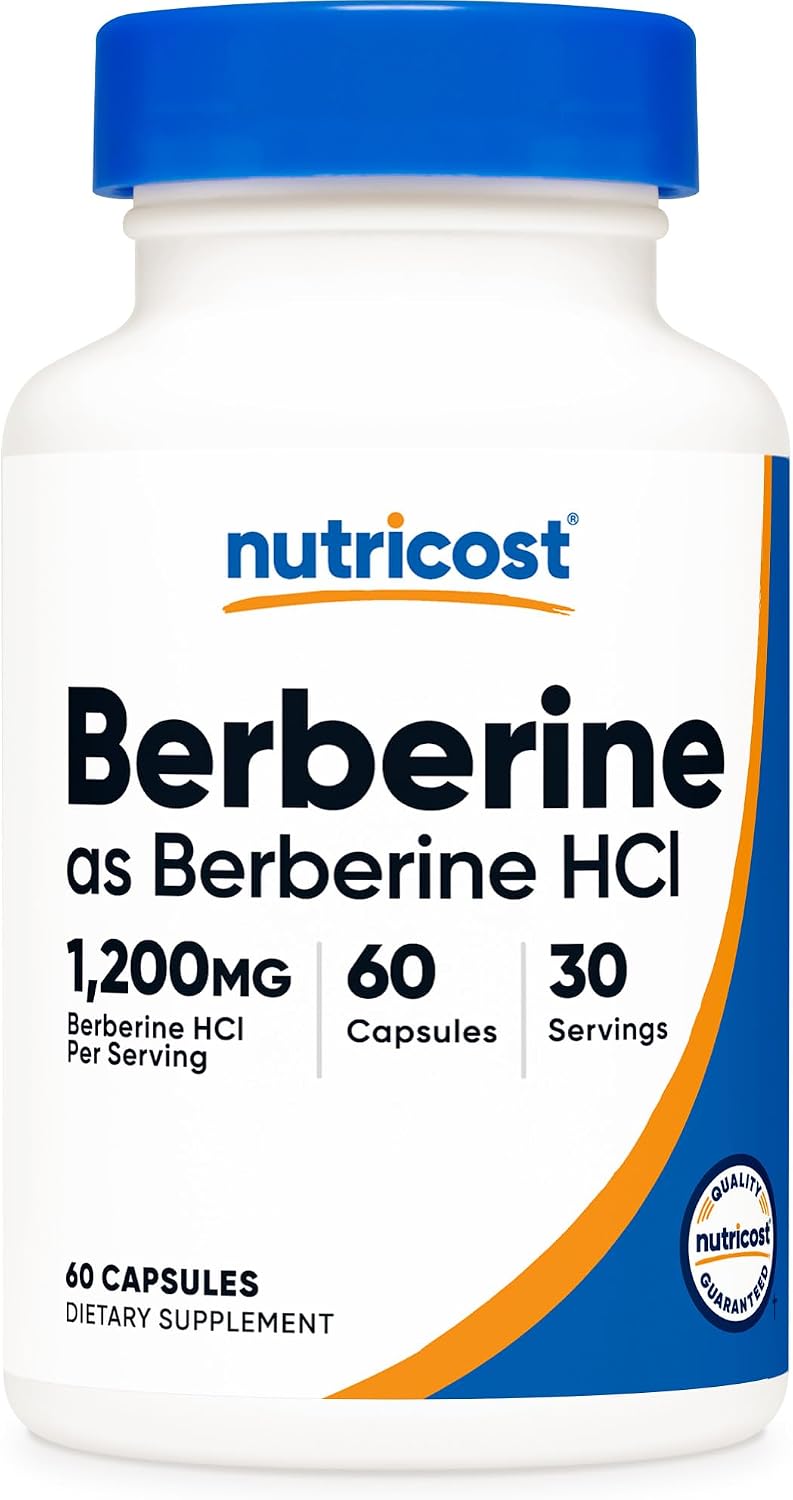
Nutricost Berberine
$18.99
This article contains affiliate links. We may earn a commission at no extra cost to you.
Berberine for Blood Sugar Control: Evidence Review
This is where the evidence is strongest, and it is the main reason most men look into berberine in the first place. If your fasting glucose or HbA1c has started drifting in the wrong direction, the question isn’t whether berberine is “natural.” The question is whether the effect size is large enough to matter on an actual lab report.
A 2022 dose-response meta-analysis of randomized controlled trials by Zamani and colleagues in Frontiers in Nutrition found that berberine reduced HbA1c by 0.45%, fasting blood glucose by 7.74 mg/dL, and HOMA-IR by 1.04, all with statistically significant results. That isn’t trivial. It’s also not a rescue plan for someone eating like an investment banker on airport layovers six days a week.
The 2023 umbrella review in Phytotherapy Research looked across 11 meta-analyses and reached the same broad conclusion: berberine significantly improves blood glucose and insulin resistance compared with controls. The consistency matters. Single studies can wobble. A pile of meta-analytic data pointing in the same direction deserves more respect.
Typical trial dosing was 500 mg taken two or three times daily before meals. That’s the practical detail many supplement headlines leave out. If you take a single underdosed capsule whenever you remember, then decide berberine “did nothing,” the problem may be execution rather than evidence.
This is also where HbA1c and fasting insulin are two of the most predictive metabolic markers you can track. Berberine may help move those markers, but the point is to measure them and see whether the change is real, not to collect another bottle and call it health strategy.
Does Berberine Improve Cholesterol and Triglycerides?
The lipid data is one reason berberine keeps coming up in serious conversations instead of only in supplement-marketing ones. In the same 2022 Frontiers in Nutrition meta-analysis, berberine reduced triglycerides by 23.70 mg/dL, total cholesterol by 20.64 mg/dL, and LDL cholesterol by 9.63 mg/dL, while increasing HDL by 1.37 mg/dL. Every one of those changes was statistically significant.
Those are meaningful shifts, especially for the man over 45 staring at a panel that looks respectable in casual conversation but not particularly reassuring once ApoB, triglycerides, and waist size are all drifting in the same direction. Cleveland Clinic points out that berberine’s lipid effects appear to be partly related to PCSK9 suppression and LDL receptor upregulation. That gives it a mechanism distinct from statins, even if the clinical impact is nowhere near “replace your prescription and freestyle it.”
The dose-response analysis suggested that 1 gram per day was the optimal dose for triglycerides and total cholesterol. That’s useful because it separates “there may be a benefit” from “here is the intake range most often associated with it.” Supplements are often sold like personality traits. Dosing brings the conversation back to adult supervision.
This is also where context matters. A small LDL reduction may be worth considering if you’re close to goal and working through lifestyle changes. It isn’t a clever workaround for someone who clearly needs guideline-based lipid management and wants to outsource that fact to a botanical compound. Berberine may be part of the picture. It shouldn’t become an excuse.
Weight Management: What the Research Says
The weight-loss claims around berberine deserve a cold shower. There is evidence of benefit, but the magnitude is modest. In the 2022 review by Zamani and colleagues, berberine reduced body weight by 0.84 kg and BMI by 0.25 kg/m2. Those are real changes. They aren’t the sort of changes that justify the louder corners of the internet acting like berberine is a legal loophole in human metabolism.
The National Center for Complementary and Integrative Health adds an important qualifier: weight effects were mainly seen at doses above 1 gram per day for more than eight weeks, and many participants in the studies had diabetes or fatty liver disease. That matters because results in metabolically compromised populations don’t always map cleanly onto a generally healthy 52-year-old with five stubborn extra pounds and a heroic confidence in his weekend tennis.
The 2023 umbrella review in Phytotherapy Research also found significant effects on body composition parameters, but again, modest ones. So the right expectation isn’t “take this and watch the belt notch disappear.” The right expectation is “if your metabolic health is off, this may help nudge several markers in a better direction while you do the unglamorous work that actually drives body composition.”
That’s why our food-first versus supplement-first decision framework exists in the first place. Supplements can support a plan. They aren’t the plan. When men get this backward, the supplement cabinet starts to look like an expensive museum of delayed honesty.
Berberine vs. Metformin: Similarities and Key Differences
Berberine and metformin do share a meaningful overlap: both activate AMPK by inhibiting mitochondrial complex I. That similarity is real, which is why comparisons keep showing up. But Cleveland Clinic makes a useful point in its review of berberine versus metformin: similar mechanism doesn’t mean equivalent tool.
One major difference is bioavailability. Berberine has less than 1% oral bioavailability, while metformin lands around 50% to 60%. That matters because it tells you something about reliability and dose handling before you even get to outcomes. Another difference is the depth of evidence. Well-controlled berberine trials are much shorter, roughly six months at the long end, while metformin has more than 60 years of safety data and cardiovascular outcome evidence behind it.
Berberine may show more pronounced lipid-lowering effects than metformin because it also inhibits PCSK9 and upregulates LDL receptors. So yes, there are scenarios where berberine does something metformin doesn’t do as well. But that still doesn’t make it “natural metformin,” which is one of those phrases that sounds smart right up until you examine it for six seconds.
The bigger practical difference for many men over 45 is drug interaction risk. Berberine inhibits CYP3A4, CYP2D6, and CYP2C9. That creates a wider interaction profile than metformin, which is one reason any comparison that stops at “they both hit AMPK” is leaving out the part that can actually cause trouble.
If your goal is to sort out whether a supplement trial makes sense, compare them honestly. Shared mechanism, different absorption, different evidence depth, different interaction burden, different regulatory status. Close cousins at one family reunion. Not twins.
Safety, Dosing, and Drug Interactions for Men Over 45
This is the section to read slowly. Trial dosing usually lands at 500 mg taken two to three times daily before meals, for a total of 1,000 to 1,500 mg per day. The common side effects are gastrointestinal: nausea, diarrhea, constipation, and abdominal discomfort. None of that is unusual for compounds that affect metabolism and gut signaling, but “it’s natural” isn’t an antidote to a miserable stomach.
The more important issue is interactions. Cleveland Clinic, Harvard Health Publishing, and NCCIH all flag meaningful risks. Berberine can interact with statins, potentially increasing muscle-pain risk through CYP3A4 inhibition. It can interact with warfarin and raise bleeding risk. It has a documented dangerous interaction with cyclosporine in renal transplant patients. It can also amplify the effect of some blood pressure medications and increase the risk of hypoglycemia when combined with diabetes drugs.
For men over 45, that list isn’t academic. This is the age range where people often start layering prescriptions on top of supplements while assuming every bottle lives in its own little diplomatic territory. It doesn’t. If you are taking a statin, antihypertensive medication, anticoagulant, diabetes medication, or immunosuppressant, this is worth discussing with your clinician before you experiment.
It’s also worth buying from a company with credible quality control rather than from a sketchy marketplace listing with a label designed by someone who thinks flames communicate trust. If you’re comparing products, our guide to premium third-party tested supplement brands is the more useful rabbit hole.
Who is this not for? Anyone looking for a substitute for real diabetes care, anyone taking multiple interacting medications without medical oversight, and anyone who wants a social-media version of metabolic medicine. Harvard Health Publishing is right to be skeptical of berberine-versus-Ozempic comparisons. The evidence doesn’t support that leap. If you’re considering berberine, take the boring route and consult your provider with your medication list and latest labs in hand. Boring is underrated. Boring also keeps people out of trouble.
Frequently Asked Questions
How long does berberine take to lower blood sugar and cholesterol?
Most of the clinical trials cited in Frontiers in Nutrition, Phytotherapy Research, and NCCIH ran for at least several weeks, with weight effects often showing up after more than eight weeks. That means berberine is better thought of as a medium-term trial tied to follow-up labs, not something you judge after four days.
Should I cycle berberine or take breaks from it?
The available evidence here doesn’t establish a strong cycling protocol, and the better-supported approach is to judge it by tolerance, medication interactions, and repeat lab results rather than supplement folklore. If side effects or interactions become an issue, that is a reason to stop and reassess with your clinician.
Does berberine interact with statins or blood pressure medication?
Yes, it can. Cleveland Clinic notes interaction concerns with statins through CYP3A4 inhibition, and the evidence summarized here also flags additive hypotensive effects with some blood pressure medications. If you’re on either, treat this as a medication-conversation supplement, not a casual add-on.
Is berberine safe to take every day for long-term metabolic support?
The evidence base isn’t deep enough to treat long-term daily use as settled fact. The longest well-controlled trials are much shorter than the decades of data available for metformin. The short-term safety profile is reasonably understood, mostly gastrointestinal side effects, but long-term use should be judged more cautiously.
How does berberine compare to taking metformin for prediabetes?
They overlap mechanistically through AMPK activation, but they aren’t equivalent. Metformin has better bioavailability, a much deeper safety record, and far more clinical history. Berberine may help some metabolic markers, including lipids, but it isn’t a one-for-one substitute for prescription therapy.
The Bottom Line on Berberine Benefits for Men Over 45
The evidence suggests berberine can modestly improve blood sugar, lipids, and body weight, especially in men with existing metabolic issues. That makes it a reasonable supplement to evaluate, not a miracle to believe in. If your labs justify the experiment and your medication list allows it, berberine may earn a place in the plan, but the plan still matters more than the capsule.
Sources
- Cleveland Clinic: Berberine – What It Is, Benefits and Side Effects
- Cleveland Clinic: Berberine vs. Metformin
- Frontiers in Nutrition (2022): The effects of berberine supplementation on cardiovascular risk factors in adults
- Phytotherapy Research (2023): Berberine and health outcomes – An umbrella review
- National Center for Complementary and Integrative Health: Berberine and Weight Loss – What You Need To Know
- Harvard Health Publishing: Can berberine help me lose weight?
Continue reading: Read the pillar — Supplements & Nutrition
This article is for informational purposes only and is not financial advice. Consult a qualified professional for personalized guidance.
Leave a Reply