

Choosing between the Garmin Epix and Fenix as an executive isn’t really about features. It’s about tolerance for friction. How much do you care about charging, how much do you care about screen quality, and how often do you want your watch to disappear into the background instead of behaving like another device that needs managing?
That’s why the Garmin Epix vs Fenix executive debate keeps hanging around even after Garmin folded AMOLED models into the Fenix 8 family. The hardware overlap is enormous. The practical experience isn’t. One line leans toward vivid display and office-friendly polish. The other still leans toward endurance, sunlight readability, and the kind of battery life that makes most smartwatches look like needy interns.
For a 55-year-old executive who trains before work, checks recovery metrics between meetings, and doesn’t want to waste money on the wrong premium wearable, the decision is fairly simple once the tradeoffs are stripped of marketing varnish. Garmin built two versions of the same answer. The trick is knowing which inconvenience bothers you less.
AMOLED vs. MIP: The Display Divide That Defines Your Choice
This is the real split. Everything else is details around the edges.
The Epix Pro (Gen 2) uses a 1.4-inch AMOLED display with 454×454 resolution, while the Fenix 7 Pro uses a 1.4-inch memory-in-pixel display at 280×280, according to GarminRumors’ device summaries for the Epix Pro and Fenix 8 families. In plain English, the Epix screen looks richer, sharper, and more premium the second you glance at it indoors. Maps pop. Training charts look better. The watch face feels closer to a high-end phone screen than a traditional outdoor watch.
The Fenix 7 Pro’s MIP screen does something less glamorous and more useful: it stays readable in harsh sun and sips power. That matters if most of your real use happens outdoors, on a golf course, on a trail, or during long training blocks where charging is an annoyance instead of a mild inconvenience.
Garmin complicated this in a good way with the Fenix 8 launch in August 2024. As Garmin‘s own press release and GarminRumors both note, the Fenix family now spans AMOLED and MIP Solar options. In other words, Garmin absorbed the old Epix logic into the flagship line. The old product boundary is gone, but the decision is still the same one: vivid indoor display or maximum endurance.
For most executives, AMOLED wins the first impression test and MIP wins the six-month ownership test. The first matters in a store. The second matters when you are packing for a three-day trip and realize your watch charger is still on the bathroom counter at home.
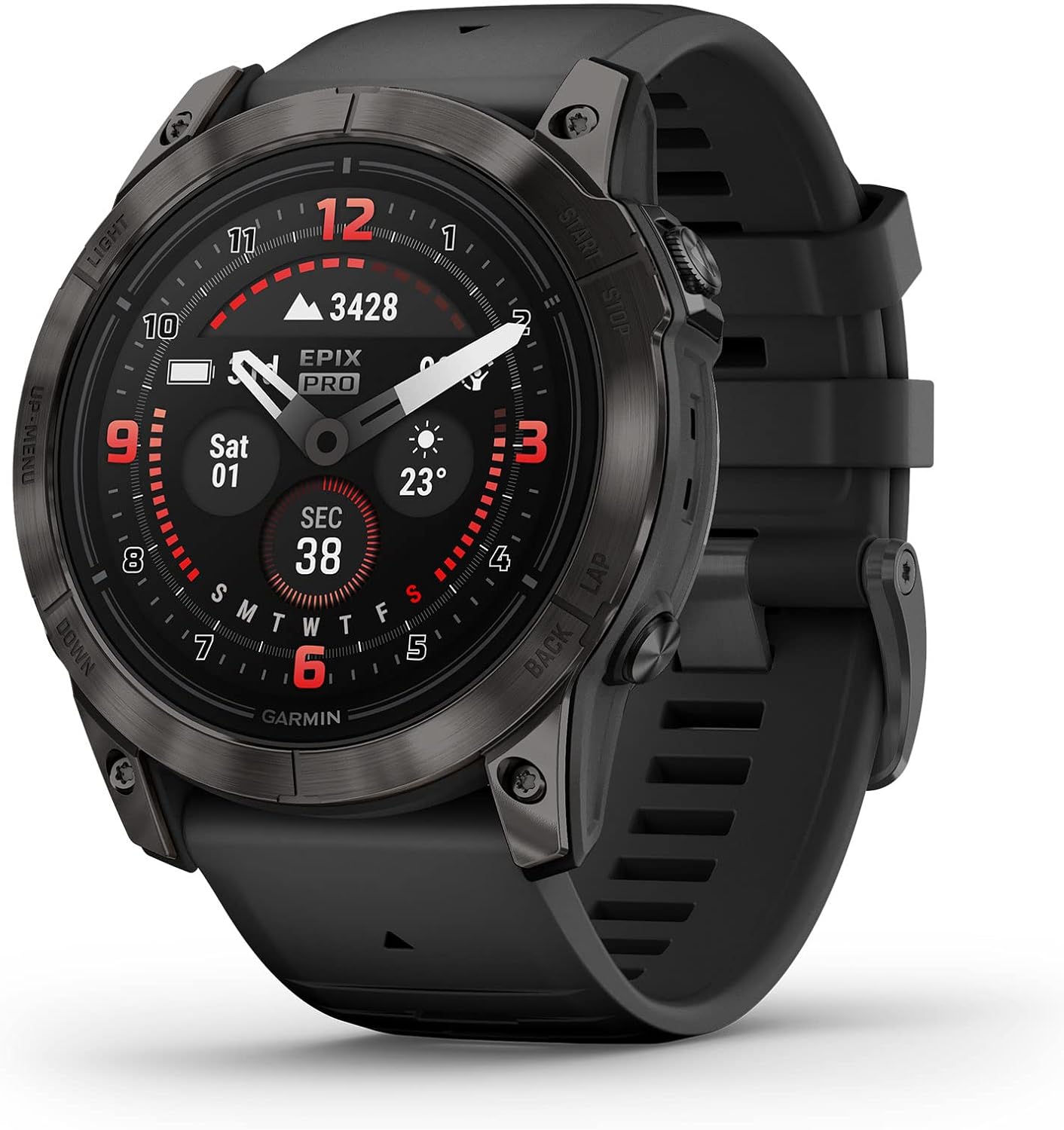
Garmin Epix
This article contains affiliate links. We may earn a commission at no extra cost to you.
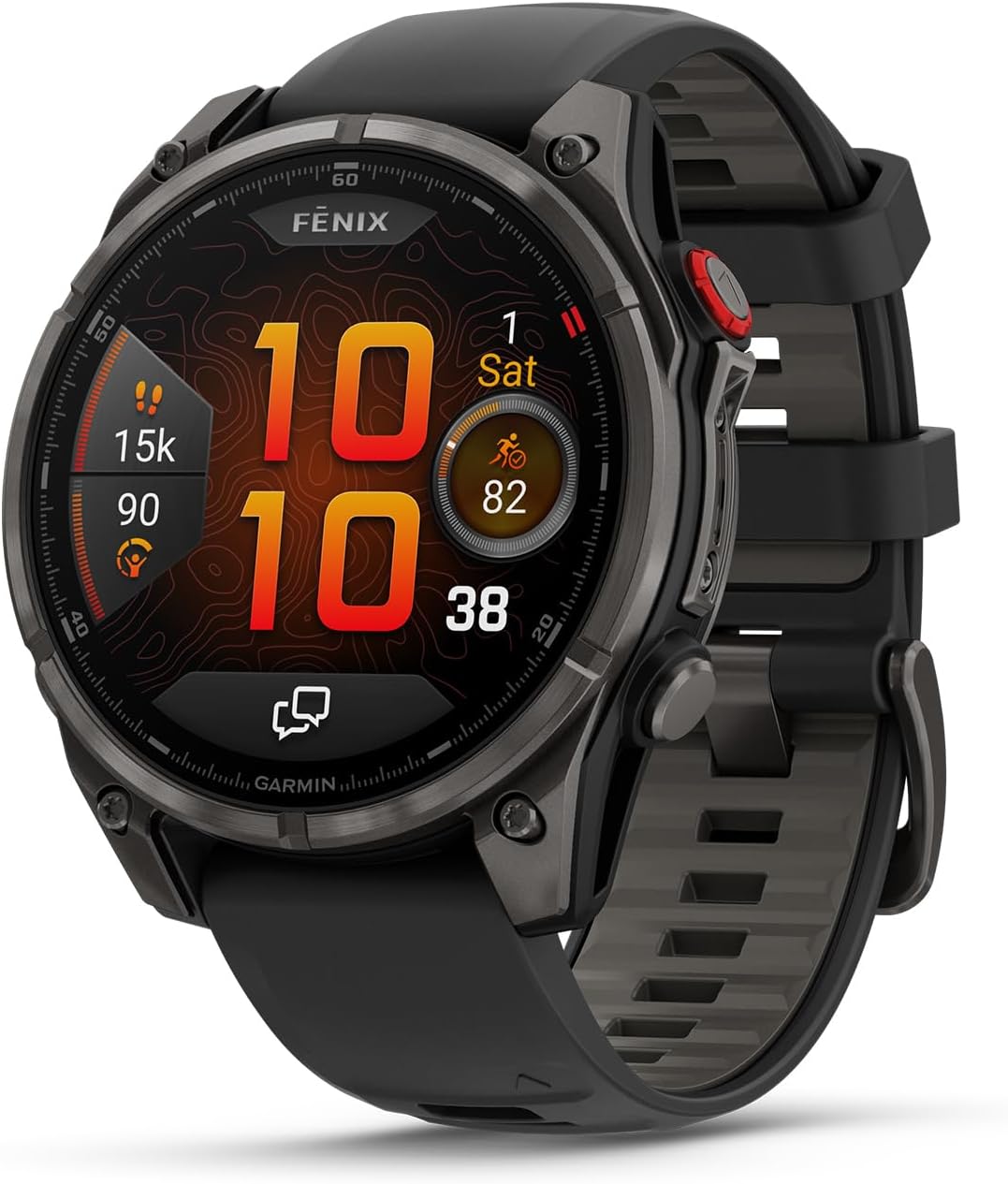
Garmin Fenix
- Multisport GPS smartwatch with built-in inReach technology for two-way satellite and LTE connectivity.
- Rugged design with a bright 1.4″ AMOLED touchscreen display, titanium bezel, scratch-resistant sapphire lens and other premium materials
This article contains affiliate links. We may earn a commission at no extra cost to you.
Battery Life: How Far Can Each Watch Go Before Needing a Charge?
Battery life is where Garmin stops being subtle.
Garmin says the Fenix 7X Pro Solar can reach up to 37 days in smartwatch mode and 122 hours in GPS-only mode. The Epix Pro (Gen 2) 47mm, by contrast, is rated for up to 6 days with always-on display, up to 16 days with gesture mode, and up to 42 hours in GPS-only mode. Garmin’s 2024 Fenix 8 announcement also claims up to 29 days for the 51mm AMOLED version and up to 48 days for the 51mm Solar model, with a 50% solar gain over the prior generation.
Those aren’t rounding errors. They are different ownership models.
If you are the kind of person who already charges a phone, earbuds, tablet, laptop, and maybe a ring or recovery strap, the Epix adds one more weekly habit. That may be perfectly fine. The screen payoff is real. But the Fenix Solar models live in a different category. They are for people who want to put the watch on and more or less forget about battery management for weeks.
That’s especially relevant for travel. A watch that lasts through flights, hotel nights, workouts, and a long weekend without negotiation is simply easier to live with. The Fenix earns its price in reduced nuisance, which isn’t a glamorous spec but is often the one that decides whether a premium tool feels premium.
There is also an executive-use wrinkle here. Most people don’t need expedition-level endurance. They need enough battery that sleep tracking, morning workouts, all-day notifications, and occasional GPS sessions don’t force midweek charging. If that is your pattern, the Epix Pro and Fenix 8 AMOLED are completely workable. If your baseline standard is, “I don’t want to think about charging this thing,” the Solar Fenix models are still the clear answer.
Core Fitness and Navigation Features: More Alike Than Different
This is where comparison articles often waste everyone’s time. They act as if the Epix and Fenix are philosophically different machines. They aren’t.
Garmin’s Epix Pro product page and DC Rainmaker’s in-depth review make the overlap obvious: multi-band GNSS with SatIQ, the Elevate Gen 5 heart-rate sensor with ECG support, Pulse Ox, Body Battery, training readiness, endurance score, hill score, TopoActive mapping, 43,000-plus golf courses, 2,000-plus ski resorts, Garmin Pay, and 32GB of storage. For core training, navigation, and health tracking, the Epix Pro (Gen 2) and Fenix 7 Pro are functionally the same class of device.
That means this isn’t an Apple Watch versus Garmin problem. This is a Garmin versus slightly different Garmin problem. The recovery metrics, route guidance, golf utility, and training stack are already premium on both sides.
The Fenix 8 does widen the gap a bit with a built-in speaker and microphone, voice-call support, dive capability to 40 meters, and a redesigned interface, according to Garmin and DC Rainmaker. Those are meaningful additions, but only for specific buyers. If you don’t dive, and if taking a call from your watch sounds more like a party trick than a need, they are nice extras rather than decisive features.
This matters because it keeps the buying decision honest. You aren’t paying for a better training brain when you move from one line to the other. You are paying for packaging choices around that same training brain.
Build Quality and Materials: When Does Extra Ruggedness Actually Matter?
Both lines are built like they expect to be knocked around. That part is settled.
GarminRumors and DC Rainmaker both describe the familiar formula: fiber-reinforced polymer cases, stainless-steel or titanium bezels, MIL-STD-810 testing, and 10 ATM water resistance. For normal use, that is already more durability than most buyers will ever test. Gym sessions, business travel, hiking, swimming, golf, and everyday wear aren’t going to separate these watches.
The Fenix 8 does add two practical upgrades: leakproof inductive buttons and EN13319-certified dive support to 40 meters. If you actually dive, that isn’t trivia. It’s a real distinction. If you don’t dive, it mostly belongs in the category of “good to have, unlikely to matter.”
The Epix Pro’s titanium variants also make sense for buyers who care about shaving weight on the wrist. Over a twelve-hour day, lighter does matter a little, especially if you wear the watch to bed for sleep tracking. But it isn’t enough to overturn the larger screen-and-battery tradeoff.
Most active executives should think about ruggedness in a boring way. Does the watch survive real life without becoming fussy? Yes. Both do. The dive rating and inductive buttons on the Fenix 8 matter for edge cases, not for the average buyer who alternates between the office, the gym, and the occasional long weekend outside.
The 2026 Product Landscape: Why the Epix Line Has Been Consolidated Into Fenix
If the current lineup feels a little confusing, that is because Garmin changed the naming without changing the underlying logic.
Garmin launched the Fenix 8 on August 27, 2024, and brought AMOLED into the Fenix family instead of spinning it out as a separate Epix follow-up. There is no Epix 3. The Epix Pro (Gen 2), released in May 2023, now sits in an odd but useful spot: not the newest flagship, but still a fully serious watch with nearly all the same core training hardware.
That creates a surprisingly rational buying window. Kotaku reported discounting on the Epix Pro Sapphire edition down to roughly $500 in 2026, while Garmin’s current flagship pricing remains meaningfully higher. For a buyer who wants the AMOLED experience and doesn’t care about the Fenix 8’s speaker, microphone, or dive additions, the Epix Pro can be the rare premium gadget that gets cheaper without becoming obsolete.
Garmin’s broader business momentum supports that logic. Bicycle Retailer reported Garmin fitness-segment revenue of $2.36 billion in 2025, up 33% year over year, with record consolidated revenue of $7.25 billion. That doesn’t tell you which watch to buy, but it does tell you the platform is healthy, heavily used, and unlikely to be treated like a side project.
So the product landscape is cleaner than it looks. Buy discounted Epix Pro if value matters more than owning the newest badge. Buy Fenix 8 if you want Garmin’s current flagship logic, especially if AMOLED plus newer hardware refinements justify the premium. Buy Fenix Solar if battery life is still the real reason you are here.
Garmin Epix vs Fenix Executive Decision Framework: Which One Should You Buy?
For comparable models, the price gap usually lands somewhere around $100 to $200, according to Garmin pricing and Wareable’s comparison. That’s enough money to matter, but not enough to rescue a bad fit. The wrong premium watch is just an expensive reminder that you bought a spec sheet instead of a tool.
Buy the Epix Pro or Fenix 8 AMOLED if you care most about screen quality, spend plenty of time indoors, want charts and maps to look excellent at a glance, and don’t mind charging roughly once a week. That buyer usually trains daily, wears the watch with office clothes, and wants the device to feel refined rather than purely utilitarian.
Buy the Fenix 7 Pro Solar or Fenix 8 Solar if you want long battery life, do frequent outdoor sessions, travel often, or simply hate the idea of another device that needs regular charging. This is the better fit for someone doing multi-day hiking, long race weekends, or any routine where battery anxiety is more irritating than a less flashy screen.
Who is the AMOLED recommendation not for? Anyone who already knows small charging habits drive them crazy. Who is the Solar recommendation not for? Anyone who wants the best-looking display on the wrist and will resent a dimmer screen every time they check it indoors.
That’s the whole decision. Ignore the mythology. These watches live in the same Garmin ecosystem, pull from the same Connect and Connect IQ world, and share most of the same serious training value. The question isn’t which watch is objectively better. The question is whether you want premium display or premium endurance.
Frequently Asked Questions
Will the Epix Pro receive the same software updates as the Fenix line going forward?
Not necessarily feature for feature, but the Epix Pro is close enough to the Fenix 7 Pro in core hardware that support should remain credible for a while. The bigger point is that Garmin has already merged the AMOLED concept into Fenix, so the Epix line is no longer the center of the roadmap.
Does the Fenix 8 speaker and microphone work with iPhone or just Android?
Garmin and DC Rainmaker both flag the speaker and microphone as Fenix 8 additions, but they aren’t the kind of feature most buyers should treat as platform-defining. In practical terms, think of them as useful extras rather than the main reason to choose the watch, unless hands-free watch functions matter to your routine.
Is the GPS accuracy on the Epix Pro the same as the Fenix 7 Pro?
For most buyers, yes. Garmin’s Epix Pro page and DC Rainmaker’s review point to the same multi-band GNSS and SatIQ foundation used in the Fenix 7 Pro class, which means accuracy differences are unlikely to decide the purchase.
Which Garmin watch works best for golf course navigation and shot tracking?
Either line works well because both include Garmin’s large golf-course library and mapping features. If golf is the priority and battery life matters during long rounds and travel, the Fenix Solar models have the edge. If you want prettier visuals on the course, the Epix screen is the more attractive option.
Should you wait for the next Fenix generation or buy the Fenix 8 now?
If the Fenix 8 already fits your priorities, waiting is usually a tax on your own patience. The stronger hesitation case is on value, not timing: if a discounted Epix Pro gives you the same day-to-day experience you actually care about, paying flagship pricing just for newer branding may not buy much.
We use and recommend Garmin for reliable performance tracking across both training and daily life. Garmin’s Fenix and Epix lines offer the most complete multisport feature set available — and right now you can check current pricing on Amazon. Check current pricing →
For an active executive, this isn’t a difficult call once the marketing fog clears. If you want the sharper screen and can live with weekly charging, buy the AMOLED version that fits your budget, whether that is a discounted Epix Pro or a newer Fenix 8. If you want the watch to behave like a quiet, durable tool that rarely asks for attention, buy the Solar Fenix and move on.
This article contains affiliate links. We may earn a commission if you sign up through these links, at no additional cost to you.
Sources
- Garmin. “Garmin Adds AMOLED Displays to Fenix 8 Series, Its Most Capable Lineup of Premium Multisport GPS Smartwatches.” August 27, 2024. https://www.garmin.com/en-US/newsroom/press-release/outdoor/garmin-adds-amoled-displays-to-fenix-8-series-its-most-capable-lineup-of-premium-multisport-gps-smartwatches-with-something-for-everyone/
- GarminRumors. “Fenix 8.” 2024. https://wiki.garminrumors.com/Fenix_8
- GarminRumors. “Epix Pro (Gen 2).” 2023. https://wiki.garminrumors.com/Epix_Pro_(Gen_2)
- Garmin. “Epix Pro (Gen 2) Product Page.” 2023. https://www.garmin.com/en-US/p/894067
- DC Rainmaker. “Garmin Epix Pro Gen 2 In-Depth Review.” May 2023. https://www.dcrainmaker.com/2023/05/garmin-epix-pro-gen2-in-depth-review.html
- DC Rainmaker. “Garmin Fenix 8 Review.” 2024. https://www.dcrainmaker.com/2024/08/garmin-fenix-8-review.html
- Wareable. “Garmin Fenix 8 vs Epix 2 Pro.” 2024. https://www.wareable.com/garmin/garmin-fenix-8-vs-epix-2-pro-comparison-13293
- Bicycle Retailer. “Garmin Posts Record Revenue in 2025.” February 18, 2026. https://www.bicycleretailer.com/industry-news/2026/02/18/garmin-posts-record-revenue-2025-and-17-growth-q4
- Tom’s Guide. “Garmin Fenix 7 Pro vs Garmin Epix Pro.” 2023. https://www.tomsguide.com/face-off/garmin-fenix-7-pro-vs-garmin-epix-pro
This article is for informational purposes only and is not financial advice. Consult a qualified professional for personalized guidance.
Leave a Reply