
If you’ve had the experience of looking at a hormone panel, seeing a number drift lower than it used to be, and then falling into a supplement rabbit hole, welcome to modern male aging. One tab says DHEA is the missing key. Another says pregnenolone is the real upstream play. A third promises that both will help you feel 35 again, which is usually where the nonsense starts.
Here’s the straight take on DHEA pregnenolone supplementation aging men over 50 keep hearing about: the biology is real, the decline with age is measurable, and the sales pitch runs far ahead of the evidence. These hormones sit upstream in steroid production, so the logic sounds clean. Fill the reservoir, improve the downstream output, and maybe get some testosterone, energy, mood, or cognitive benefit along the way. Human trials are much messier than that.
The current evidence says DHEA has limited, uneven benefits and hasn’t delivered broad anti-aging effects in controlled trials. Pregnenolone has a more interesting early signal, especially around mood, pain, and working memory, but the evidence base is thinner and long-term safety is less settled. For a time-poor man over 50, that’s the useful answer: plausible mechanism, mixed data, no magic bullet.
What Are DHEA and Pregnenolone, and Why Do They Decline With Age?
DHEA and pregnenolone aren’t fringe wellness inventions. They are real steroid precursors your body makes naturally, and both decline as you age. According to the NCBI Bookshelf overview on reproductive steroid hormones, DHEA-S levels typically peak in early adulthood and then fall by about 2% per year. By the 70s, circulating levels are often down to 10% to 20% of peak. That’s a steep drop, not a rounding error.
Pregnenolone follows a similar pattern. A 2023 paper in the International Journal of Environmental Research and Public Health reported that pregnenolone levels can fall by roughly 60% between ages 35 and 75, or around 2% to 3% per year. So when a 56-year-old notices he doesn’t recover, focus, or sleep quite the same way he did at 42, it isn’t irrational to ask whether shifting upstream hormones are part of the picture.
The important framing is this: age-related decline isn’t the same thing as a disease that automatically needs treatment. Testosterone falls with age too, but not every lower number justifies an intervention. The same applies here. A measurable decline explains why these supplements are interesting. It doesn’t prove supplementing them will produce a meaningful result.
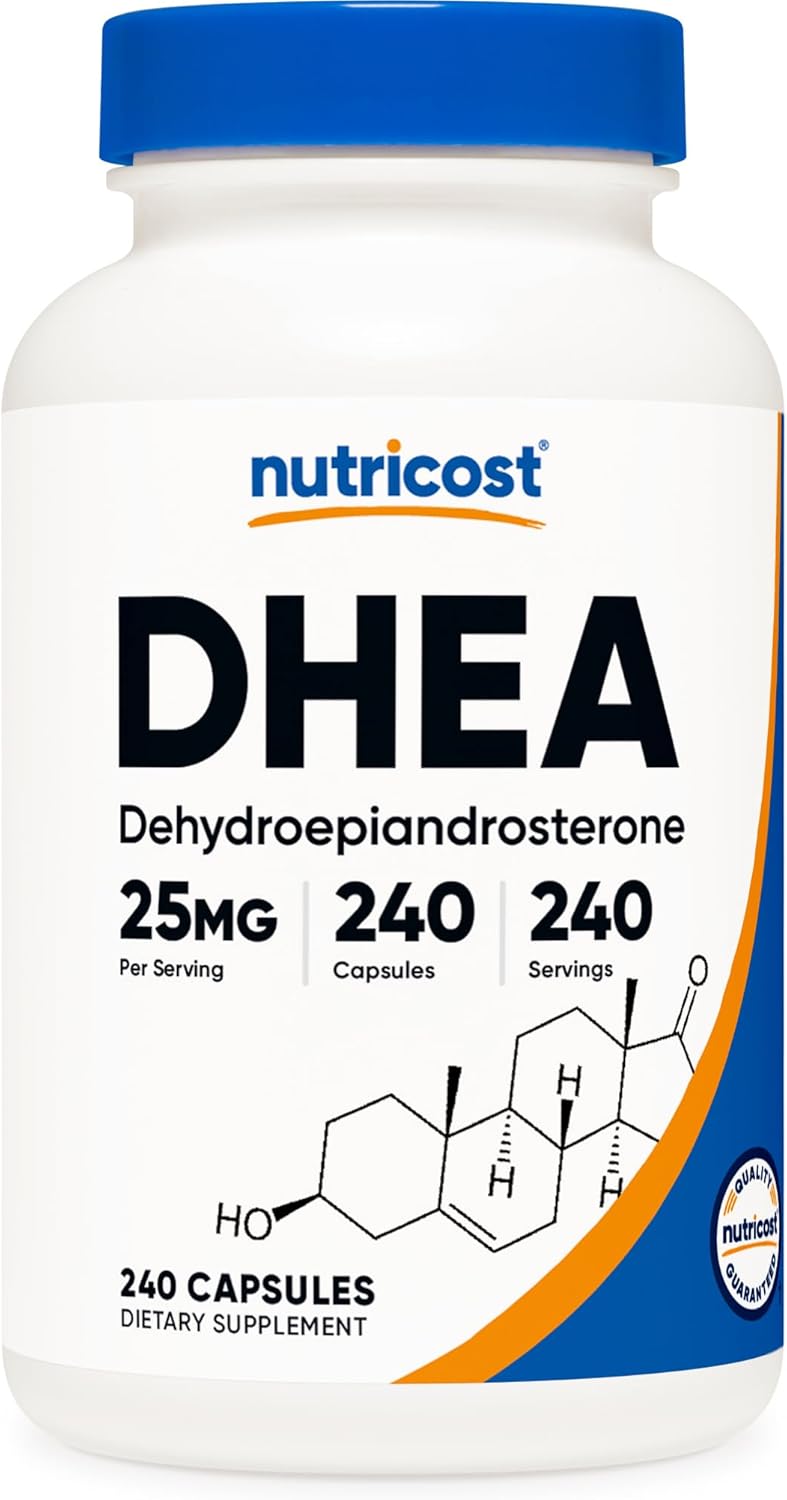
Nutricost DHEA 25mg
$14.95
This article contains affiliate links. We may earn a commission at no extra cost to you.
DHEA Pregnenolone Supplementation Aging Men Over 50: Why the Hormone Logic Sounds So Good
Pregnenolone is often called the mother hormone because the steroid pathway starts there. The NCBI Bookshelf review on steroid hormone synthesis lays out the chain clearly: pregnenolone feeds the Delta-5 and Delta-4 pathways that eventually produce testosterone, DHEA, cortisol, progesterone, and estrogens. DHEA then contributes to androgen production through peripheral conversion to androstenedione and then testosterone.
That’s the biochemical reason these supplements keep getting positioned as a smart shortcut. If upstream supply is lower, maybe downstream hormones and related functions suffer. Refill the upstream tank and the rest of the system should cooperate. On paper, that sounds tidy.
Human endocrine systems, unfortunately, aren’t tidy. They are more like old commercial plumbing. Water pressure matters, but so do valves, leaks, blockages, and whether the building was designed well in the first place. Adding more precursor doesn’t guarantee a clinically meaningful change in the exact tissue, pathway, or symptom you care about.
For men over 50, that distinction matters. A plausible mechanism is a reason to study something. It isn’t proof that the intervention deserves a permanent spot in the supplement drawer next to fish oil, magnesium, and three things bought during an unusually persuasive podcast ad.
DHEA Supplementation: What the Controlled Trials Actually Found
DHEA is the more heavily marketed option, but the controlled evidence isn’t especially flattering. Harvard Health summarized a Mayo Clinic two-year randomized trial in older adults where DHEA levels were restored to a more youthful range. The result was the kind of finding supplement marketers prefer to leave in very small print: no detectable improvement in body composition, physical performance, insulin sensitivity, or quality of life.
That doesn’t mean DHEA does nothing. Harvard Health also notes that meta-analytic data suggest modest shifts in body composition, including some increase in lean mass and some decrease in fat mass. But those changes did not translate into stronger muscles. That’s a pretty common disappointment in this category. Looking slightly better on paper isn’t the same as performing better in the gym, at work, or in daily life.
Effects on cognition and bone density are also inconsistent. Mayo Clinic’s 2024 review doesn’t support DHEA as a reliable anti-aging intervention and advises against using it for that purpose. That isn’t a fringe opinion. It’s the mainstream reading of the evidence: there may be narrow effects, but the broad rejuvenation story doesn’t hold up.
For a skeptical reader, this is the useful separation. DHEA may alter a few surrogate markers or body-composition measures at the margins. It hasn’t shown the kind of durable, across-the-board benefit that would justify treating it like a default play for aging men. If someone is selling DHEA as the thing that brings back strength, drive, insulin control, mood, and vitality in one move, that person is describing a business model more than a dataset.
Pregnenolone Supplementation: The Emerging Evidence Base
Pregnenolone is less famous than DHEA, but the early data are more interesting. A 2023 study in the International Journal of Environmental Research and Public Health found that men with pregnenolone levels below 180 ng/dL had significantly higher rates of low testosterone, depression, and memory complaints. That doesn’t prove causation, but it does suggest low pregnenolone may travel with the symptoms men actually care about.
Intervention data are still limited, but the signals aren’t trivial. Research summarized by EBSCO’s 2024 review of pregnenolone as a therapeutic supplement reported that 30 mg daily improved working memory in some studies, with effects appearing within two to four weeks. Another randomized trial in military veterans with chronic low back pain found about a 20% pain reduction with pregnenolone compared with roughly 6% on placebo.
That’s enough to take pregnenolone seriously. It isn’t enough to treat it as settled science. Compared with DHEA, the story here is more “promising but early” than “debunked.” There are fewer large randomized controlled trials, fewer long-term data sets, and less clarity on which subgroup of men is most likely to benefit.
For aging men over 50, the most defensible read is that pregnenolone may have more upside for cognition, mood, or pain than DHEA has for generalized anti-aging claims. But “may” is doing real work in that sentence. The mechanism is plausible, the human data are still thin, and thin data are where the longevity internet starts improvising. That never ends well.
Risks, Regulation, and the Supplement Quality Problem
This is where the cheerful supplement narrative usually runs into a wall. DHEA isn’t FDA-approved for general anti-aging, energy, or testosterone support. Mayo Clinic notes that its approved medical use is limited and that over-the-counter supplement versions aren’t regulated for purity and potency the way prescription drugs are. That means the label and the capsule aren’t always close friends.
The known risks aren’t cosmetic. Harvard Health and Mayo Clinic both point to concerns including reduced HDL cholesterol and the possibility that DHEA could aggravate hormone-sensitive conditions, including prostate or breast cancers. Long-term use may also suppress the body’s own production. For a man already uneasy about prostate risk or lipid drift, that isn’t background noise. That’s the decision.
Pregnenolone has a lighter risk file in the published literature, but that shouldn’t be mistaken for a clean bill of health. It mostly means it has been studied less. Long-term safety data are limited, and the same supplement-quality problem applies. If you are buying hormones in a bottle from a market that treats quality control like an optional personality trait, caution isn’t overkill.
This is also why no serious take on these compounds can ignore testing and supervision. The reader this brand is written for has probably already spent money on supplements that promised precision and delivered vibes. Hormones deserve a higher bar than vibes.
A Practical Framework: Should You Supplement DHEA or Pregnenolone?
No major medical organization currently recommends routine DHEA or pregnenolone supplementation for normal age-related decline in men. That’s the clean answer. The more nuanced answer is that a supervised trial may be reasonable in a narrower group: men with documented low DHEA-S or pregnenolone on lab testing, symptoms that actually match the biology, and no obvious contraindications such as prostate-cancer history or liver concerns.
Test first. That shouldn’t be controversial, but in the supplement world it apparently still qualifies as radical restraint. If you don’t know your DHEA-S, pregnenolone, testosterone, lipids, and broader clinical context, you aren’t making a hormone decision. You are buying a story.
Then get specific about the goal. If the real issue is low libido and clinically low testosterone, DHEA or pregnenolone isn’t a substitute for an honest TRT conversation with your provider. If the issue is brain fog, low mood, or poor recovery with borderline labs, pregnenolone may be worth discussing because the early evidence is more relevant there. If the goal is to feel younger in a vague, expensive way, the evidence doesn’t support much confidence.
The sensible framework is conservative: confirm low levels, match the intervention to the symptom pattern, rule out reasons not to use it, monitor labs, and stop pretending that “natural” means low risk. DHEA looks modest at best. Pregnenolone looks intriguing but preliminary. Neither deserves routine use just because the birthday cake now has enough candles to set off a smoke alarm.
Frequently Asked Questions
Can DHEA or pregnenolone replace testosterone replacement therapy (TRT)?
Usually no. These are upstream precursors, not direct testosterone replacement. Some men may see downstream hormone effects, but the evidence doesn’t support DHEA or pregnenolone as reliable substitutes for TRT in men with clear hypogonadism. If low testosterone is the core issue, consult your provider rather than trying to reverse-engineer endocrine care from a supplement label.
How long does it take to see effects from DHEA or pregnenolone supplementation?
The limited pregnenolone research suggests working-memory effects may appear within two to four weeks at 30 mg daily in studied settings. DHEA results are less impressive and often inconsistent even over much longer periods. If nothing meaningful changes after a monitored trial, that is information, not a reason to keep buying another bottle.
Do you need a prescription for DHEA or pregnenolone, or are they over the counter?
In the United States, both are commonly sold over the counter as supplements. That doesn’t make them casual. It mostly means the regulatory standard is lower than many buyers assume. Potency, purity, and batch consistency can vary, which is one reason medical supervision matters more, not less.
Can you take DHEA and pregnenolone together, or do they compete for the same pathways?
They sit in the same steroid-hormone network, so taking both isn’t automatically irrational, but it is also not automatically smart. More precursor doesn’t guarantee better outcomes, and combined use makes it harder to tell what is helping, what is doing nothing, and what may be pushing a lab marker in the wrong direction. If a clinician isn’t guiding the experiment, the experiment may be guiding you.
Will DHEA or pregnenolone show up on a standard blood test for hormone levels?
Not always. Standard testosterone panels often don’t include DHEA-S or pregnenolone. If those hormones are part of the question, they usually need to be ordered directly. That’s another reason not to assume you can infer an upstream hormone problem from symptoms alone.
DHEA and pregnenolone decline with age, and that decline helps explain why these supplements attract so much attention from men over 50. But evidence and marketing aren’t remotely in the same tax bracket here: DHEA looks underwhelming in controlled trials, while pregnenolone has a more interesting but still early evidence base. If this topic applies to you, the grown-up move is simple: test first, match the intervention to the actual problem, and keep a very short leash on claims that sound better than the data.
This article is for informational purposes only and is not financial advice. Consult a qualified professional for personalized guidance.
Leave a Reply